A property loss can be far more than a repair expense for a business owner.
A roof leak can damage inventory.
A burst pipe can force a business to close temporarily.
A fire can affect equipment, furniture, and the building itself.
A severe storm can interrupt operations for days or weeks.
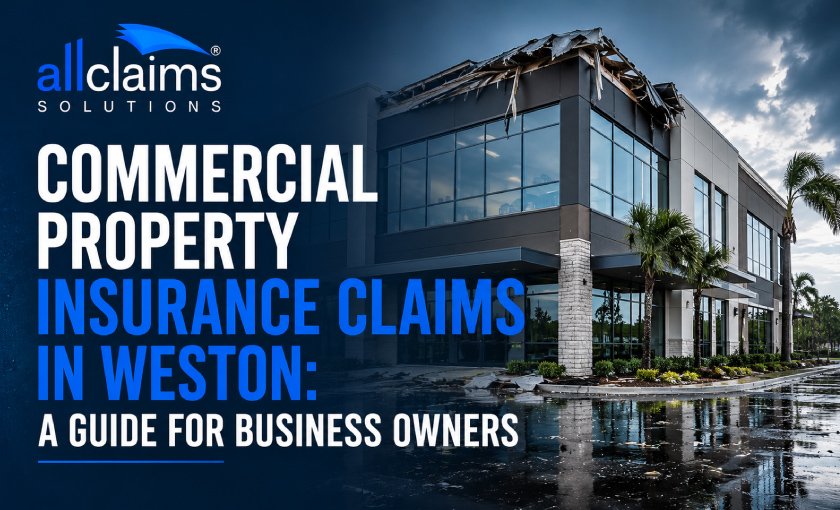
For business owners in Weston, FL, understanding how commercial property insurance claims work can make an important difference when a covered loss occurs.
Commercial property policies can include coverage for buildings, business personal property, equipment, business income, extra expenses, and other exposures—but the exact coverage depends on the policy, endorsements, limits, deductibles, exclusions, and cause of loss. Florida’s Department of Financial Services emphasizes that commercial policies vary between insurers and recommends that business owners carefully review their individual policy.
At All Claims Solutions, our Public Adjusters help property owners and business owners document damage, prepare insurance claims, and navigate the claims process.
We Work for You—not the Insurance Company.
What Is a Commercial Property Insurance Claim?
A commercial property insurance claim is a request for coverage after a business property experiences damage from a potentially covered event.
Depending on the policy, a commercial property claim may involve damage to:
- Commercial buildings
- Offices
- Retail stores
- Restaurants
- Warehouses
- Professional spaces
- Equipment
- Furniture
- Inventory
- Fixtures
- Interior finishes
- Business personal property
A claim can also potentially involve financial losses associated with a temporary interruption of business operations.
The exact coverage depends on the policy and the circumstances of the loss.
What Types of Commercial Property Damage Can Lead to an Insurance Claim?
Weston businesses can experience many different types of property losses.
Water Damage
Water damage may result from:
- Burst pipes
- Plumbing failures
- Water heater failures
- Appliance leaks
- Roof leaks
- HVAC problems
- Accidental water discharge
Water can damage drywall, flooring, ceilings, inventory, furniture, equipment, and other business property.
Our existing article on Water Damage Insurance Claims in Weston can be used here as an important internal link.
Roof and Storm Damage
Severe weather can damage commercial roofing systems and allow water to enter the building.
A roof claim may involve:
- Roofing materials
- Interior ceilings
- Walls
- Insulation
- Flooring
- Equipment
- Inventory
- Furniture
The visible roof damage may only be part of the total loss.
Fire and Smoke Damage
A commercial fire can create several different categories of damage:
- Structural damage
- Smoke damage
- Soot contamination
- Water damage from firefighting
- Equipment damage
- Inventory loss
- Furniture damage
- Business interruption
Fire claims can therefore become significantly more complicated than simply calculating the cost of rebuilding the burned area.
Wind Damage
Wind can damage:
- Roofs
- Windows
- Doors
- Exterior walls
- Signage
- Outdoor equipment
In some cases, wind damage can also create secondary water intrusion.
Mold Damage
Mold can develop after a covered water loss, roof leak, plumbing failure, or other moisture event.
Commercial mold claims can be especially complicated because the loss may affect both the physical property and the business’s ability to operate.
What Does Commercial Property Insurance Cover?
There is no single answer that applies to every business.
Florida’s Department of Financial Services explains that commercial property coverage can be written through different policy structures, including Commercial Package Policies (CPPs) and Business Owners Policies (BOPs). These policies can contain different coverage forms, causes of loss, conditions, endorsements, deductibles, and limits.
Depending on the policy, commercial property insurance may provide coverage for areas such as:
Building
The physical commercial structure.
Business Personal Property
Property used in the operation of the business.
Equipment
Machinery, computers, appliances, tools, and other business equipment.
Inventory
Products and merchandise stored at the property.
Business Income
Potential income losses resulting from a covered interruption.
Extra Expense
Certain additional expenses incurred to keep the business operating after a covered loss.
These coverages are not automatically included in the same way in every policy, so business owners should review their specific declarations, coverage forms, endorsements, limits, and exclusions.
Commercial Property Claims and Business Income Losses
One of the biggest mistakes business owners can make is focusing only on the physical damage.
Imagine a Weston restaurant experiences significant water damage.
The building needs repairs.
But the financial impact may extend beyond the damaged walls and flooring.
The restaurant may also experience:
Property Damage
→ Temporary closure
→ Lost revenue
→ Additional operating expenses
→ Relocation costs
→ Business interruption
Depending on the policy, business income and extra expense coverage may help address certain financial losses associated with a covered interruption.
This is why a commercial property claim should be evaluated as a business loss, not simply as a construction estimate.
What Is Business Interruption Insurance?
Business interruption coverage—often referred to as business income coverage—can help address certain losses when a covered property event prevents or limits normal business operations.
Potentially relevant expenses or losses can include:
- Lost business income
- Continuing operating expenses
- Payroll
- Temporary relocation expenses
- Additional expenses required to continue operations
However, coverage varies significantly by policy.
Business owners should not assume that every interruption or revenue loss is automatically covered.
The policy’s business income provisions, waiting periods, limits, exclusions, and documentation requirements should be carefully reviewed.
What Should a Weston Business Owner Do After Property Damage?
The first few days after a commercial property loss can be critical.
1. Protect People First
Make sure employees, customers, and visitors are safe.
If the property has structural, electrical, fire, or other hazards, follow appropriate emergency procedures.
2. Stop the Source of Damage
If it is safe and appropriate, take reasonable steps to prevent additional damage.
Examples may include:
- Shutting off water
- Covering damaged areas
- Securing broken windows
- Protecting inventory
- Arranging emergency mitigation
3. Document Everything
Take photographs and videos of:
- Exterior damage
- Interior damage
- Roof damage
- Water intrusion
- Damaged equipment
- Inventory
- Furniture
- Fixtures
- Structural damage
- Debris
- Temporary repairs
Don’t focus only on the most obvious damage.
4. Create an Inventory
A commercial property claim may involve hundreds or thousands of individual items.
Document:
- Product name
- Quantity
- Approximate age
- Purchase price
- Current condition
- Serial numbers where available
- Photographs
- Receipts or invoices
Florida’s Department of Financial Services recommends keeping important insurance and property documents and maintaining accurate inventory information for commercial property coverage.
5. Keep All Receipts
Save documentation for:
- Emergency repairs
- Water extraction
- Temporary protection
- Equipment rental
- Storage
- Cleaning
- Temporary relocation
- Replacement items
- Other loss-related expenses
These records can become important when documenting the claim.
Why Documentation Is So Important for Commercial Claims
A commercial property claim can involve significantly more information than a typical residential claim.
For example, imagine a retail business suffers water damage.
The claim could potentially involve:
Building
- Drywall
- Flooring
- Ceiling
- Cabinets
- Electrical components
Business Property
- Computers
- POS equipment
- Furniture
- Fixtures
Inventory
- Products
- Packaging
- Materials
Financial Impact
- Lost revenue
- Continuing expenses
- Additional expenses
Without organized documentation, some portions of the loss may be difficult to evaluate.
Common Commercial Property Insurance Claim Mistakes
Mistake #1: Focusing Only on Visible Damage
The visible damage may not represent the complete scope of the loss.
Mistake #2: Forgetting Business Personal Property
Equipment, furniture, inventory, and other business property can represent a substantial portion of a commercial claim.
Mistake #3: Ignoring Business Income Loss
A business may lose significant revenue even when the physical repairs appear straightforward.
Mistake #4: Throwing Away Damaged Items Too Quickly
Whenever reasonably possible, document damaged property before disposing of it and follow the insurer’s instructions.
Mistake #5: Making Permanent Repairs Before Documentation
Emergency measures may be necessary to prevent further damage, but extensive repairs can make it more difficult to document the original condition.
Mistake #6: Assuming the Insurance Company’s Estimate Is the Final Word
The insurer’s estimate is part of the claims process—not necessarily a complete representation of every aspect of the business’s loss.
Mistake #7: Not Reviewing the Policy
Commercial insurance policies can contain complex provisions concerning:
- Covered causes of loss
- Deductibles
- Limits
- Coinsurance
- Exclusions
- Endorsements
- Business income
- Extra expense
Florida’s Department of Financial Services specifically recommends that business owners read their commercial property policies carefully because policies differ between insurers.
What Is Coinsurance in a Commercial Property Policy?
Coinsurance is an important concept that business owners should understand.
Depending on the policy, failing to maintain adequate insurance limits can affect how a claim is paid.
Florida’s Department of Financial Services warns that businesses with replacement-cost coverage can be penalized when they fail to maintain the proper amount of insurance.
For this reason, business owners should periodically review:
- Building values
- Equipment values
- Inventory
- Improvements
- Current construction costs
- Business income exposure
This is especially important as the cost of rebuilding or replacing property changes over time.
Commercial Property Claims After a Hurricane or Storm
Severe weather can create complicated commercial insurance claims.
A single storm may produce:
Wind Damage
→ Roof Damage
→ Water Intrusion
→ Interior Damage
→ Equipment Damage
→ Inventory Loss
→ Business Interruption
This is why storm claims should be documented comprehensively.
Don’t assume that because the roof is the most obvious problem, the roof is the only part of the claim.
What If Your Commercial Property Claim Is Denied?
A denied claim can be particularly stressful for a business owner.
Before accepting the denial, review:
The Denial Letter
What specific reason did the insurance company provide?
The Policy
Which exclusion or limitation is the insurer relying on?
The Cause of Loss
What actually caused the property damage?
The Documentation
Do photographs, reports, invoices, estimates, or other evidence support your position?
The Scope of Damage
Was the entire loss properly documented?
If you believe your commercial property claim has been denied or improperly limited, professional claim assistance may be appropriate.
Our existing Denied Insurance Claim Help in Weston, FL article should be linked here.
What If Your Commercial Property Claim Is Underpaid?
A commercial claim doesn’t have to be completely denied to create a problem.
An insurer may accept the claim while disagreeing about:
- Scope of damage
- Repair costs
- Replacement costs
- Business personal property
- Inventory
- Business income
- Additional expenses
- Applicable coverage
This can result in an underpaid commercial property insurance claim.
A detailed claim presentation can help organize the evidence supporting the full documented loss.
Can a Public Adjuster Help With a Commercial Property Claim?
Yes. A Public Adjuster can represent the policyholder during the insurance claims process.
Florida’s Department of Financial Services describes a Public Adjuster as a professional who represents the policyholder and can assist with claim documentation, filing, and settlement negotiations. Public Adjusters must be licensed by the Florida Department of Financial Services.
For a commercial property claim, a Public Adjuster may assist with:
Property Inspection
Evaluating the scope of physical damage.
Documentation
Organizing photographs, measurements, inventories, estimates, invoices, and other evidence.
Policy Review
Identifying potentially relevant coverages, limits, deductibles, exclusions, and endorsements.
Claim Preparation
Preparing a detailed presentation of the documented loss.
Business Property
Documenting equipment, inventory, furniture, fixtures, and other affected property.
Business Income
Helping organize documentation related to applicable business income or extra expense losses.
Communication
Assisting with communications during the claims process.
Negotiation
Representing the policyholder in discussions concerning the documented claim.
Florida also advises consumers to verify that a Public Adjuster is properly licensed and to carefully review any contract before signing.
When Should a Business Owner Consider Hiring a Public Adjuster?
There is no requirement that a business owner hire a Public Adjuster.
However, professional claim assistance may be worth considering when:
- The damage is extensive
- Multiple types of property are affected
- The claim involves business interruption
- Inventory was damaged
- Equipment was damaged
- The insurance company disputes the scope
- The claim is underpaid
- The claim has been denied
- The loss is difficult to document
- The business owner doesn’t have time to manage the claim
Florida’s Department of Financial Services notes that hiring a Public Adjuster does not guarantee a higher payout or faster claim handling, so business owners should consider the costs and benefits and review the contract carefully.
Commercial Property Insurance Claims in Weston
Weston businesses can include a wide range of commercial properties, from professional offices and retail spaces to restaurants, service businesses and other commercial operations.
Regardless of the type of business, a property loss can affect both the physical property and the ability to operate.
That’s why the goal should not simply be:
Repair the building.
It should be:
Understand, document, and properly present the full covered loss.
Why Weston Business Owners Choose All Claims Solutions
When a commercial property loss occurs, business owners have enough to worry about.
You may need to:
- Protect employees
- Communicate with customers
- Manage vendors
- Replace equipment
- Protect inventory
- Find temporary space
- Maintain operations
- Deal with your insurance company
At All Claims Solutions, our Public Adjusters help property owners and business owners throughout Weston and surrounding South Florida communities navigate the property insurance claims process.
Our approach focuses on:
INSPECT
↓
DOCUMENT
↓
REVIEW
↓
PREPARE
↓
PRESENT
↓
NEGOTIATE
We Work for You—not the Insurance Company.
Frequently Asked Questions About Commercial Property Insurance Claims in Weston
Coverage varies by policy, but commercial property insurance can potentially cover buildings, business personal property, equipment, inventory, business income, extra expenses, and other exposures depending on the policy and endorsements.
Potentially covered losses can include certain fire, wind, water, storm, theft, or other covered causes of loss. The applicable coverage depends on the commercial policy and cause of loss.
Some commercial policies include business income or business interruption coverage. The applicable policy provisions, limits, waiting periods, and exclusions should be reviewed.
Protect people, take reasonable steps to prevent additional damage, document the property, create an inventory of damaged business property, save receipts, and report the loss according to the policy requirements.
Review the denial letter, policy language, cause of loss, and supporting documentation. If you disagree with the decision, consider obtaining professional assistance to evaluate the claim.
You can review the insurer’s estimate against the documented scope of damage and applicable coverage. Additional documentation may be needed to support portions of the loss that were not included.
A licensed Public Adjuster can represent a policyholder in the claims process, including helping document the loss, prepare the claim, and negotiate with the insurance company.
Yes. Florida Public Adjusters must be licensed by the Department of Financial Services. Business owners should verify the adjuster’s license and carefully review the contract before signing.
Get Help With a Commercial Property Insurance Claim in Weston, FL
A commercial property loss can affect much more than your building.
It can impact your:
Property
Equipment
Inventory
Employees
Revenue
Operations
Business
If your Weston business has experienced water damage, roof damage, storm damage, fire damage, or another property loss, understanding the full scope of the claim is an important first step.
Don’t let an insurance claim become another problem for your business.
All Claims Solutions – Weston Public Adjusters
We Work for You—not the Insurance Company.
No Recovery – No Fee.
Insurance coverage varies by polichis article is provided for general informational purposes only and does not constitute legal advice or a determination of insurance coverage. Commercial insurance coverage varies by policy, insurer, endorsements, exclusions, limits, deductibles, and the circumstances of the loss.y and circumstances. This article is for general informational purposes and is not legal or insurance coverage advice.
Schedule Your Free Property Inspection
All Claims Solutions – Weston, FL
📍 2645 Executive Park Dr. Suite 629, Weston, FL 33331
📞 (954) 622-0088
allclaimssolutions.com