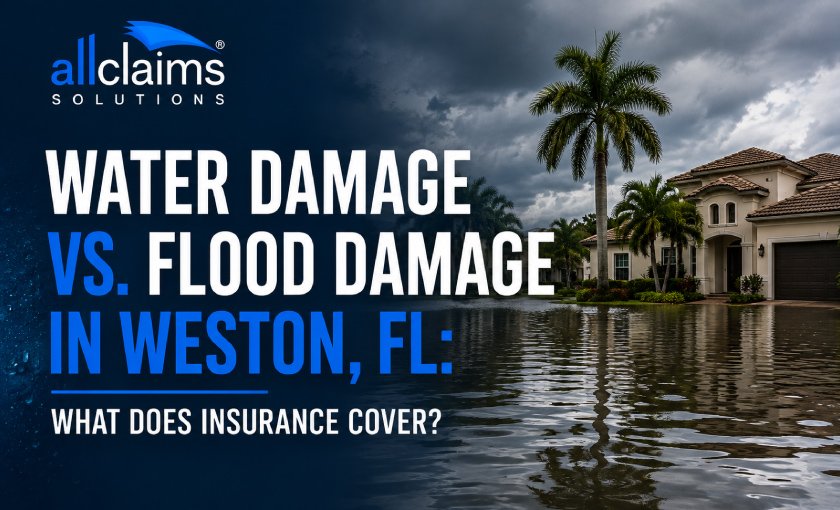
Water damage and flood damage can look very similar, but insurance policies may treat them very differently.
For homeowners and property owners in Weston, FL, understanding the difference can become especially important after heavy rain, tropical storms, hurricanes, plumbing failures, roof leaks, or other water-related events.
The City of Weston states that homeowners insurance generally does not cover flood damage and encourages property owners to consider separate flood insurance. Weston also participates in the National Flood Insurance Program’s Community Rating System, which provides eligible residents with discounts on NFIP flood insurance.
So, when water enters your property, one of the first questions to ask is:
Where did the water come from?
That answer can have a significant impact on which insurance coverage may apply.
At All Claims Solutions, our Public Adjusters help property owners in Weston and surrounding South Florida communities document property damage, prepare insurance claims, and navigate the claims process.
We Work for You—not the Insurance Company.
Water Damage vs. Flood Damage: Why the Difference Matters
In everyday conversation, people often use “water damage” and “flood damage” to describe the same thing.
Insurance policies, however, can make an important distinction.
A sudden pipe failure inside your home may be considered a water damage loss.
Water entering your property because of rising surface water may instead fall under the definition of flood damage.
The Florida Department of Financial Services explains that standard homeowners insurance generally excludes flood damage, while flood insurance is designed to address qualifying losses caused by rising water.
This means that simply seeing water inside your home does not tell you which coverage applies.
You need to understand:
- The source of the water
- What caused the water intrusion
- When the damage occurred
- What your insurance policy says
- Whether you have flood insurance
- Whether an endorsement applies
What Is Water Damage?
Water damage generally refers to damage caused by water from a specific source affecting your property.
Examples can include:
- Burst pipes
- Plumbing failures
- Water heater leaks
- Appliance leaks
- HVAC leaks
- Certain roof leaks
- Accidental discharge of water
- Rain entering through a storm-damaged roof
Whether a particular loss is covered depends on the policy and circumstances.
A sudden and accidental event may be treated differently from a long-term leak, deterioration, or maintenance issue.
What Is Flood Damage?
Flood damage involves water that meets the applicable policy’s definition of a flood.
Flooding can involve:
- Rising surface water
- Overflowing waterways
- Stormwater runoff
- Certain coastal or storm-related flooding
- Water accumulating on normally dry land
- Other qualifying sources of rising water
The Florida Department of Financial Services explains that the typical definition of flood includes overflow of inland or tidal waters and runoff of surface water from any source.
This distinction is particularly important in Florida because heavy rainfall and tropical weather can produce different types of water-related losses during the same event.
Does Homeowners Insurance Cover Flood Damage in Weston, FL?
Generally, no.
The City of Weston specifically states that homeowners insurance policies do not cover loss caused by flooding.
The Florida Department of Financial Services likewise states that most homeowners insurance policies exclude flood damage and that property owners may need a separate flood insurance policy or applicable endorsement.
This is why homeowners should not assume that their standard homeowners policy automatically protects them from rising floodwater.
Does Homeowners Insurance Cover Water Damage?
It may.
Coverage depends on the cause of the water damage and the specific terms of the policy.
For example, a sudden and accidental plumbing failure may potentially be covered, while damage caused by a long-term unresolved leak may be excluded or limited.
Other issues can include:
- Wear and tear
- Lack of maintenance
- Repeated leakage
- Sewer backup
- Flooding
- Gradual seepage
- Excluded causes of loss
The Florida Department of Financial Services notes that sewer or drain backup may not typically be covered unless specific coverage is added by endorsement. It also emphasizes that water-backup coverage does not provide coverage for flood damage.
Water Damage vs. Flood Damage: Real-World Examples
Understanding the distinction becomes easier with examples.
Example 1: Burst Pipe Inside a Weston Home
A pipe suddenly breaks inside your house.
Water spreads through the property and damages:
- Drywall
- Flooring
- Cabinets
- Baseboards
- Personal property
This may be considered a water damage claim under your homeowners policy, depending on the circumstances and policy language.
Example 2: Rising Water Enters the Property
Heavy rainfall causes water to accumulate outside the property.
The water rises and enters the home.
This type of loss may fall under the definition of flood and generally would not be covered by a standard homeowners policy.
Applicable flood insurance would need to be reviewed.
Example 3: Hurricane Damages the Roof
A storm damages your roof.
Rain then enters through the opening and damages the ceiling and interior.
The claim could involve:
Storm/Wind Damage
↓
Roof Damage
↓
Rain Intrusion
↓
Interior Water Damage
This is different from water entering because of rising floodwater.
The actual policy and circumstances determine how the loss is handled.
Example 4: Water Backs Up Through a Drain
A drain or sewer backs up and water enters the property.
This can raise a different coverage question.
The Florida Department of Financial Services notes that water-backup coverage may be available through an endorsement, while such coverage does not cover flood damage.
Can One Storm Cause Both Water Damage and Flood Damage?
Yes.
This is particularly important after severe weather in South Florida.
Imagine a major storm hits Weston.
Step 1
High winds damage the roof.
Step 2
Rain enters through the damaged roof.
Step 3
The ceiling and walls become saturated.
Step 4
Heavy rainfall produces significant surface water.
Step 5
Rising water enters the property from outside.
Now you may have multiple causes of damage from the same weather event.
That’s why saying:
“My house was damaged by the storm.”
may not provide enough information to understand the insurance claim.
A detailed evaluation should examine how each portion of the damage occurred.
Why Flood Risk Matters in Weston, FL
Weston has a significant stormwater-management system consisting of interconnected lakes and canals, drainage infrastructure, culverts, and pump stations. The City emphasizes that maintaining unobstructed water flow is important for reducing flooding during storm events.
The City also encourages property owners to understand their FEMA flood zone.
Broward County’s updated FEMA flood maps became effective July 31, 2024, and the City of Weston recommends that homeowners and businesses review their current flood-zone information.
Importantly, being outside a high-risk flood zone does not mean a property cannot flood.
The City specifically encourages property owners outside mandatory flood zones to evaluate whether purchasing flood insurance makes sense for their circumstances.
Is Flood Insurance Required in Weston?
It depends on the property’s location and circumstances.
According to the City of Weston, if the structure is located within a Special Flood Hazard Area, FEMA flood-insurance requirements may apply. Properties outside the Special Flood Hazard Area generally are not subject to a federal mandatory purchase requirement, although a mortgage lender may still require flood insurance.
Even when flood insurance isn’t mandatory, the City encourages property owners to consider purchasing it.
Weston currently participates in the NFIP Community Rating System as a Class 6 community, which can provide eligible property owners with discounts on NFIP flood insurance.
What Should You Do If Water Enters Your Weston Property?
If your property suffers water intrusion, taking organized steps early can help preserve important information about the loss.
1. Protect People First
Do not enter areas with potential electrical, structural, or other safety hazards.
2. Identify the Source
When it is safe, determine whether the water appears to come from:
- A pipe
- Roof damage
- An appliance
- HVAC equipment
- A drain
- Surface water
- Flooding
- Another source
3. Document Everything
Take photos and videos of:
- The source of the water
- Water intrusion
- Standing water
- Walls
- Ceilings
- Flooring
- Cabinets
- Roof damage
- Personal property
- Exterior conditions
Whenever reasonably possible, document the condition before major repairs or removal of damaged materials.
4. Mitigate Further Damage
Take reasonable steps to prevent additional damage when safe and appropriate.
Keep:
- Emergency-service invoices
- Receipts
- Contractor documentation
- Repair estimates
- Photographs
- Inspection reports
5. Notify Your Insurance Company
Follow the reporting requirements in your policy.
Keep a record of:
- Claim number
- Date reported
- Adjuster information
- Communications
- Inspections
- Estimates
- Coverage decisions
What If the Insurance Company Says It Is Flood Damage?
This can become one of the most important points in a water damage claim.
If the insurance company says the loss resulted from flooding, carefully review:
1. The insurer’s explanation
Understand why the carrier classified the loss as flood damage.
2. The policy language
Review the applicable definitions, exclusions, and coverage provisions.
3. The source of the water
Determine where the water originated.
4. The timeline
Document when the water entered and how the damage progressed.
5. The physical evidence
Photographs, videos, inspection reports, and repair documentation can help establish the circumstances of the loss.
The critical question is not simply:
“Was there water?”
It is:
“What caused the water to enter the property?”
What If My Water Damage Insurance Claim Is Denied?
Insurance companies may deny or limit water-related claims for various reasons.
For example, the insurer may argue that the damage resulted from:
- Flooding
- Long-term seepage
- Wear and tear
- Lack of maintenance
- An excluded cause
- Pre-existing damage
- Sewer backup
- Another policy exclusion
If your claim is denied, review the denial letter carefully and compare it with the applicable policy provisions.
A denial should not simply be accepted without understanding why the insurer reached that conclusion.
A licensed Public Adjuster may be able to help evaluate the documented property damage and assist with the claims process.
What About Mold After Water Damage?
Mold can become a secondary problem after water intrusion.
The progression can look like:
Water Damage
↓
Moisture
↓
Wet Building Materials
↓
Mold Growth
Mold may develop behind:
- Drywall
- Cabinets
- Flooring
- Baseboards
- Walls
- Ceilings
- Insulation
If water damage has occurred, property owners should address moisture promptly and document the affected areas.
Our related Mold Insurance Claims in Weston, FL article can provide additional information about how mold coverage may be treated under a property insurance policy.
Water Damage and Commercial Properties in Weston
The water-versus-flood distinction isn’t limited to residential properties.
Weston businesses can experience:
- Plumbing failures
- Roof leaks
- Storm damage
- Flooding
- Equipment damage
- Inventory damage
- Structural damage
- Business interruption
Commercial property insurance policies can contain different coverage provisions and limitations than residential policies.
For business owners, documenting both physical property damage and the financial impact of a covered loss can be critical.
How a Public Adjuster Can Help With a Water Damage Claim
A Public Adjuster represents the policyholder, rather than the insurance company.
For a complex water-related claim, a Public Adjuster may help with:
Property Inspection
Documenting visible damage and identifying areas that may require additional investigation.
Damage Documentation
Organizing photographs, measurements, estimates, and supporting evidence.
Cause-of-Loss Documentation
Helping organize evidence concerning the origin and progression of the damage.
Policy Review
Reviewing relevant policy provisions, exclusions, deductibles, limits, and endorsements.
Claim Preparation
Helping prepare documentation describing the scope and value of the loss.
Insurance Communication
Assisting with claim-related communication with the carrier.
Negotiation
Representing the policyholder in discussions regarding the documented loss.
Why the Cause of Loss Matters
Consider these two scenarios:
Scenario A
Burst Pipe → Water Damage → Damaged Flooring
versus:
Scenario B
Heavy Rain → Rising Surface Water → Flooding → Damaged Flooring
The visible result may be similar:
Damaged Flooring
But the insurance analysis can be very different.
That’s why identifying the source and cause of the water is one of the most important steps in evaluating a property insurance claim.
Common Water and Flood Insurance Claim Mistakes
Assuming All Water Damage Is Covered
Different causes of water damage can receive different treatment under a policy.
Assuming Flood Damage Is Covered by Homeowners Insurance
Standard homeowners insurance generally excludes flood damage.
Waiting Too Long to Document the Damage
Evidence can disappear as repairs and cleanup take place.
Focusing Only on Visible Damage
Water can affect hidden areas behind walls, floors, and ceilings.
Throwing Away Damaged Property Without Documentation
Whenever reasonably possible, photograph and document damaged property before disposal.
Assuming a Flood Zone Determines Coverage
Your flood-zone designation and the actual terms of your insurance policy are separate considerations.
Why Weston Property Owners Choose All Claims Solutions
When water enters your home or business, determining what happened—and what insurance coverage may apply—can become complicated.
At All Claims Solutions, our Public Adjusters help property owners throughout Weston and surrounding South Florida communities navigate the insurance claims process.
Our approach is focused on:
INSPECT
↓
DOCUMENT
↓
REVIEW
↓
PREPARE
↓
PRESENT
↓
NEGOTIATE
We Work for You—not the Insurance Company.
No Recovery – No Fee.
Whether you’re dealing with water damage, storm damage, roof damage, flooding, or a combination of losses, proper documentation can make an important difference in the claims process.
Frequently Asked Questions
It may be, depending on the source of the water, the cause of the loss, and the specific policy. Sudden and accidental water losses may be treated differently from flooding, gradual leaks, or excluded causes.
Generally, no. The City of Weston states that homeowners insurance does not cover loss due to flooding. Separate flood insurance may be necessary.
The key distinction is often the source and cause of the water. A burst pipe inside the home and rising surface water outside the property can have very different insurance implications.
A sudden and accidental pipe failure may be covered depending on the policy and circumstances. Damage associated with long-term deterioration or maintenance issues may be treated differently.
It depends on how the water entered the property. Rain entering through a covered storm-damaged roof may be treated differently from rising floodwater.
No. Flood insurance is designed for qualifying flood losses and does not automatically cover every type of water damage.
Review the insurer’s explanation, the applicable policy provisions, and the evidence showing the source of the water. A Public Adjuster may be able to assist with documenting and evaluating the property damage.
A Public Adjuster can assist with eligible property insurance claims within their authority and licensing. Whether they can assist with a particular flood policy depends on the policy, claim, and circumstances.
Get Help With a Water Damage Insurance Claim in Weston, FL
Water damage can become complicated quickly.
A single storm can create multiple types of loss:
Wind Damage → Roof Damage → Rain Intrusion → Water Damage
or:
Heavy Rain → Surface Water → Flooding → Property Damage
Understanding the difference between these scenarios can be critical when evaluating insurance coverage.
If your Weston home, condo, commercial property, or business has suffered water-related damage, All Claims Solutions can help you navigate the insurance claims process.
Don’t navigate a complicated property insurance claim alone.
All Claims Solutions – Weston Public Adjusters
We Work for You—not the Insurance Company.
No Recovery – No Fee.
24/7 Service
Insurance coverage varies by policy and circumstances. This article is for general informational purposes and is not legal or insurance coverage advice.
Schedule Your Free Property Inspection
All Claims Solutions – Weston, FL
📍 2645 Executive Park Dr. Suite 629, Weston, FL 33331
📞 (954) 622-0088
allclaimssolutions.com
Types of Claims in Weston FL
Water Damage >
Fire Damage >
Storm Damage >
Flood Damage >
Mold damage >
Structural Damage >