
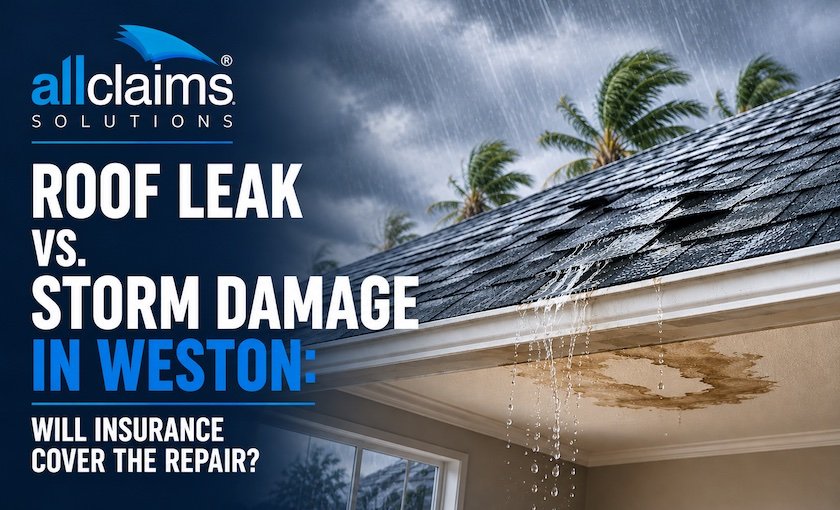
A roof leak can seem like a simple maintenance problem.
But after a major storm, heavy rain, or strong winds, determining why the roof is leaking can become an important part of an insurance claim.
For homeowners in Weston, FL, the difference between:
“My roof is leaking.”
and
“My roof was damaged by a covered storm event, causing water to enter my home.”
can be significant when evaluating an insurance claim.
A roof leak may result from:
- Storm or wind damage
- Missing or damaged shingles
- Broken roof tiles
- Damaged flashing
- Roof penetrations
- Long-term deterioration
- Wear and tear
- Poor maintenance
- Previous damage
- Plumbing or HVAC issues
The cause of the leak matters because insurance policies generally distinguish between covered damage caused by a covered peril and excluded or maintenance-related conditions.
Florida’s Department of Financial Services explains that homeowners insurance can protect against covered disasters such as hurricanes, tornadoes, tropical storms and other risks, but coverage depends on the individual policy.
At All Claims Solutions, our Public Adjusters help Weston property owners document roof and storm damage and navigate the property insurance claims process.
We Work for You—not the Insurance Company.
Is a Roof Leak Covered by Homeowners Insurance in Florida?
Sometimes—but not every roof leak is covered.
The most important question is:
What caused the roof leak?
For example, there can be a significant difference between:
Storm-Related Roof Damage
Strong winds damage roofing materials → rain enters through the damaged area → interior water damage occurs.
versus:
Long-Term Roof Deterioration
An aging roof gradually deteriorates → water begins entering the property → damage develops over time.
The first situation may potentially involve a covered storm or wind loss, depending on the policy.
The second may involve maintenance, wear and tear, or another exclusion.
The insurance policy and facts of the loss determine coverage.
Roof Leak vs. Storm Damage: What’s the Difference?
Understanding this distinction is essential when filing a roof damage insurance claim in Weston, FL.
Roof Leak
A roof leak describes the condition—water is entering the property through the roof.
It doesn’t necessarily explain why the leak occurred.
Storm Damage
Storm damage describes the cause of the property damage.
For example:
High winds
↓
Roof shingles or tiles damaged
↓
Opening created
↓
Rain enters
↓
Ceiling and interior damaged
This is very different from a roof that gradually develops leaks because of age or deterioration.
The key question is not simply:
“Is my roof leaking?”
It’s:
“What caused the roof to leak?”
What Types of Storm Damage Can Cause a Roof Leak?
Weston homeowners can experience several forms of storm-related roof damage.
Wind Damage
Strong winds can:
- Lift shingles
- Break roofing materials
- Damage flashing
- Dislodge tiles
- Damage vents
- Create openings
Heavy Rain
Rain can enter through areas that were damaged or compromised by a storm.
Fallen Trees or Branches
A tree or large branch can puncture or damage the roof.
Hail
Depending on the storm and policy, hail can damage roofing materials and create conditions that eventually lead to water intrusion.
Wind-Driven Rain
Rain entering through an opening created by covered storm damage can create significant interior damage.
How Can You Tell If a Roof Leak Was Caused by a Storm?
This is one of the most difficult questions for homeowners.
A leak discovered after a storm does not automatically prove that the storm caused the damage.
Instead, the claim may require evidence connecting the storm to the roof damage.
Useful documentation can include:
- Photographs
- Videos
- Roof inspection reports
- Contractor reports
- Weather information
- Damage patterns
- Previous roof records
- Maintenance records
- Repair invoices
- Interior water damage photographs
The goal is to establish a clear timeline:
Storm Event
↓
Roof Damage
↓
Water Intrusion
↓
Interior Damage
Why Timing Matters After a Storm
Imagine a Weston homeowner notices a ceiling stain two days after a severe storm.
The homeowner might initially assume:
“The roof is old, so this must be a maintenance issue.”
But a professional inspection could reveal:
- Recently displaced shingles
- Damaged flashing
- Wind-created openings
- Broken tiles
- New punctures
- Other storm-related damage
This is why homeowners shouldn’t automatically assume that a roof leak is simply an old-roof problem.
At the same time, homeowners should not assume that every leak discovered after a storm is covered.
Documentation and evidence matter.
What Does Insurance Look At When Evaluating a Roof Leak Claim?
The insurer may evaluate several factors, including:
Cause of Loss
What caused the damage?
Age and Condition of the Roof
How old was the roof, and what was its condition before the event?
Maintenance
Was the roof properly maintained?
Prior Damage
Was there evidence of pre-existing damage?
Storm Conditions
What weather event occurred?
Damage Pattern
Does the physical damage appear consistent with the reported event?
Interior Damage
Is there evidence that water entered through the damaged roof?
Policy Language
Does the policy provide coverage for the specific loss?
The insurer’s investigation is one part of the process. Property owners should also maintain their own documentation.
Does an Old Roof Automatically Mean Insurance Won’t Cover the Damage?
No.
Roof age can be relevant, but an older roof does not automatically mean that every subsequent roof loss is excluded.
Florida law currently provides specific rules concerning residential roof age and insurance underwriting. For example, insurers generally cannot refuse to issue or renew a homeowners policy solely because a roof is less than 15 years old, and for roofs at least 15 years old, certain inspection rights apply before requiring replacement based solely on age.
However, underwriting rules are not the same thing as claim coverage rules.
Whether damage to an older roof is covered after a storm depends on the applicable policy provisions and the facts surrounding the loss.
What If the Insurance Company Says the Roof Leak Is Wear and Tear?
This is a common point of disagreement in roof claims.
An insurer may determine that the roof damage resulted from:
- Wear and tear
- Deterioration
- Aging
- Poor maintenance
- Long-term leakage
- Defective materials
- Pre-existing damage
If the insurer makes this determination, ask for the explanation in writing and review the policy provisions supporting it.
The key question becomes:
Is there evidence that a covered event caused physical damage to the roof?
A professional inspection and detailed documentation can help establish what actually happened.
Can Storm Damage Cause Interior Water Damage?
Yes.
A storm-damaged roof can allow water to enter the property.
For example:
Wind damages roof
↓
Roof opening develops
↓
Rain enters
↓
Ceiling becomes saturated
↓
Drywall is damaged
↓
Insulation becomes wet
↓
Flooring or personal property may be affected
The resulting claim may therefore involve much more than the roof itself.
Homeowners should document both the exterior and interior damage.
What Interior Damage Should You Look For?
After discovering a roof leak, inspect the property for:
- Ceiling stains
- Bubbling paint
- Damaged drywall
- Wet insulation
- Warped flooring
- Damaged cabinets
- Moisture around windows
- Wet electrical components
- Mold or microbial growth
- Damaged furniture
- Damaged electronics
- Damaged personal belongings
Some water damage may not become immediately visible.
Hidden Roof and Water Damage
One of the biggest challenges with roof leaks is that visible damage may represent only part of the problem.
Water can travel through:
- Attic spaces
- Insulation
- Ceiling cavities
- Walls
- Flooring systems
For example, a homeowner may see a small brown spot on the ceiling.
Behind that area, there could be:
Wet insulation
Moisture inside drywall
Wood deterioration
Additional water intrusion
This is why a thorough inspection can be important when evaluating a storm-related roof leak.
Related Resource
Hidden Storm Damage: What Insurance Companies Often Miss
This should be one of the strongest internal links in this article.
What Should You Do If Your Roof Starts Leaking After a Storm?
1. Protect Your Family
If the property has structural damage or electrical hazards, stay away from unsafe areas.
2. Prevent Additional Damage
When it is safe, take reasonable emergency measures to prevent additional damage.
This may include:
- Placing containers under active leaks
- Covering exposed areas
- Arranging emergency roof tarping
- Removing standing water
- Moving belongings away from water
Florida consumer guidance recommends taking reasonable steps to protect property from further damage and documenting emergency repairs.
3. Take Photos and Videos
Document:
Exterior
- Roof
- Shingles
- Tiles
- Flashing
- Vents
- Gutters
- Fallen branches
Interior
- Ceilings
- Walls
- Floors
- Furniture
- Personal property
Take wide-angle photographs as well as close-ups.
4. Document the Date
Record:
- Date of the storm
- Date damage was discovered
- Date the leak started
- Date emergency repairs were performed
A clear timeline can be valuable.
5. Notify Your Insurance Company
Follow the reporting requirements in your policy and notify your insurer as soon as reasonably possible.
Florida law establishes specific deadlines for property insurance claims, so delaying a claim unnecessarily can create additional problems.
6. Keep Your Receipts
Save receipts for:
- Emergency roof repairs
- Tarping
- Water extraction
- Drying
- Cleanup
- Materials
- Temporary repairs
Should You Repair the Roof Before the Insurance Inspection?
Emergency repairs and permanent repairs are different.
If a roof is actively allowing water into the property, reasonable emergency measures may be necessary to prevent additional damage.
However, before making major permanent repairs, homeowners should understand their policy requirements and, when appropriate, allow the insurer an opportunity to inspect the damage.
Document the condition before repairs whenever possible.
Take photographs and videos.
Keep:
- Contractor reports
- Estimates
- Invoices
- Receipts
- Materials removed
- Photos of damaged areas
This creates a record of what existed before the permanent repair.
Can You File a Claim for a Roof Leak Months After a Storm?
Possibly, but waiting can create significant documentation problems.
A delayed claim can make it more difficult to determine:
- When the damage occurred
- What caused the leak
- Whether additional damage developed later
- Whether the condition existed before the storm
- Whether the roof was properly maintained
Florida law currently provides specific reporting periods for property insurance claims, reopened claims, and supplemental claims. The general statutory period for an initial property insurance claim is currently one year after the date of loss, while supplemental claims generally have an 18-month reporting period.
Your policy may also contain additional requirements.
If you believe your roof was damaged by a storm, don’t unnecessarily delay documenting and reporting the loss.
What If the Insurance Company Says the Roof Was Already Damaged?
This can become a significant issue in storm claims.
The insurer may argue that:
“The roof was already damaged before the storm.”
In that situation, documentation from before and after the storm can become valuable.
Useful evidence may include:
- Previous inspection reports
- Prior repair invoices
- Roofing records
- Property photographs
- Maintenance records
- Real estate inspection reports
- Drone imagery
- Contractor documentation
The goal is to establish the condition of the roof before and after the reported event.
What If Only Part of the Roof Is Damaged?
Not every storm automatically requires replacement of the entire roof.
The appropriate repair or replacement depends on:
- The extent of damage
- Roofing materials
- Policy provisions
- Applicable limits
- Matching considerations
- Building requirements
- The feasibility of repairs
When a covered loss requires replacement and the replacement items do not match in quality, color, or size, the statute provides for reasonable repair or replacement of items in adjoining areas, subject to the statute and policy provisions.
This can be particularly relevant when dealing with older roofing materials.
What About Matching Roof Materials?
Imagine a storm damages part of an older roof.
The exact roofing material is no longer readily available.
Replacing only the damaged section could create a visible difference between:
New materials
and
Existing materials
Florida’s property insurance law contains provisions addressing certain matching situations when covered losses require replacement and the replacement items do not match in quality, color, or size.
However, the statute does not mean that every damaged roof automatically qualifies for full replacement.
The policy, damage, materials, and circumstances of the loss all matter.
What Is a Roof Deductible in Florida?
Some Florida residential policies may contain a separate roof deductible.
Florida law currently permits certain policies to include a roof deductible, subject to specific requirements. The Florida Department of Financial Services explains that roof deductible provisions must be clearly presented in the policy, and the amount must appear on the declarations page.
This means homeowners should review their declarations page before assuming that the amount of a roof claim equals the amount they will receive.
The exact calculation depends on the policy and applicable circumstances.
What If My Roof Damage Is From a Hurricane?
Hurricane damage can involve additional policy considerations.
Florida residential property policies may include a hurricane deductible, and the applicable deductible can differ from the policy’s other deductibles. Florida law establishes specific rules concerning hurricane deductibles.
This is particularly important in South Florida and other parts of the state where hurricanes and tropical storms can produce extensive property losses.
Related Resource
Hurricane Damage Claims in Weston: Complete Homeowner Guide
Roof Leak vs. Flood Damage
Another important distinction is where the water came from.
Storm-Damaged Roof
Wind damages the roof → Rain enters through the damaged roof → Interior water damage.
Flooding
Floodwater rises or accumulates outside → Water enters the property.
These scenarios can involve very different coverage questions.
Homeowners should not automatically treat every form of water damage after a storm as the same type of insurance loss.
Related Resource
Water Damage vs. Flood Damage in Weston, FL: What Does Insurance Cover?
Common Roof Leak Insurance Claim Mistakes
Mistake #1: Assuming Every Leak Is Covered
A leak is a symptom, not necessarily the cause.
Mistake #2: Assuming Every Leak Is Maintenance
A roof can be old and still sustain new storm damage.
Mistake #3: Waiting Too Long to Document the Damage
The longer you wait, the harder it may become to establish the condition immediately after the storm.
Mistake #4: Only Photographing the Ceiling
The roof itself may contain important evidence.
Mistake #5: Repairing Everything Before Documentation
Permanent repairs can remove evidence of the original damage.
Mistake #6: Throwing Away Damaged Materials
When practical, document damaged materials before disposal.
Mistake #7: Ignoring Secondary Damage
Water can damage walls, ceilings, insulation, flooring, furniture, and personal property.
Mistake #8: Accepting the Insurance Estimate Without Reviewing the Scope
The insurer’s estimate should be compared against the actual documented condition of the property.
What If Your Roof Damage Claim Is Underpaid?
An insurance company may accept that a storm caused damage but disagree about:
- Scope
- Repair method
- Roofing materials
- Interior damage
- Labor
- Hidden damage
- Matching
- Replacement versus repair
This can result in an underpaid insurance claim.
If the amount offered doesn’t appear to reflect the documented damage, compare:
Insurance Estimate
vs.
Actual Documented Damage
This is where professional claim documentation can become particularly valuable.
Related Resource
Top Reasons Insurance Claims Get Underpaid in Weston, FL
What If Your Roof Damage Claim Is Denied?
A denial doesn’t necessarily mean that you should stop investigating the loss.
Ask:
Why was the claim denied?
Review the insurer’s written explanation.
What policy provision was cited?
Identify the exclusion or limitation.
What evidence supports the denial?
Review inspection reports and photographs.
Is there evidence of storm damage?
Look at the roof condition and weather event.
Is interior damage connected to the roof?
Document the water intrusion pathway.
If your claim has been denied, our existing article:
Denied Insurance Claim Help in Weston, FL: What Property Owners Can Do Next
is an important internal resource.
Can a Public Adjuster Help With a Roof Leak Claim?
Yes.
A licensed Public Adjuster represents the policyholder in the insurance claim process.
Florida’s Department of Financial Services explains that Public Adjusters represent policyholders in adjusting and presenting insurance claims, and they must be licensed by the state.
For a roof leak or storm damage claim, a Public Adjuster may assist with:
Damage Documentation
Identifying and documenting visible and potentially hidden damage.
Claim Scope
Evaluating the extent of the property loss.
Policy Review
Reviewing relevant coverage provisions, deductibles, exclusions, and limits.
Claim Preparation
Organizing photographs, estimates, reports, invoices, and other documentation.
Insurance Communication
Helping communicate with the insurance company throughout the claims process.
Negotiation
Representing the policyholder during discussions regarding the documented loss.
When Should a Weston Homeowner Consider Hiring a Public Adjuster?
Professional claim assistance may be worth considering when:
- The roof damage is extensive
- There is significant interior water damage
- Hidden damage is suspected
- The insurer disputes the cause of the leak
- The insurer says the damage is wear and tear
- The claim has been underpaid
- The claim has been denied
- Multiple areas of the property are damaged
- You are dealing with a complex storm claim
Not every roof leak requires professional representation.
But when the claim becomes complicated, having someone focused on the insurance process can help the homeowner stay organized.
How to Document a Roof Leak Insurance Claim in Weston
A strong claim starts with good documentation.
Create a file containing:
Before the Storm
- Previous roof photos
- Inspection reports
- Maintenance records
- Repair invoices
After the Storm
- Exterior photos
- Interior photos
- Videos
- Roof inspection
- Contractor estimates
Financial Documentation
- Emergency repair invoices
- Tarping receipts
- Water mitigation invoices
- Replacement estimates
Insurance Documentation
- Policy
- Declarations page
- Claim number
- Insurer correspondence
- Inspection reports
- Settlement estimates
The more organized your documentation, the easier it can be to explain the loss.
Roof Leak Insurance Claim Checklist
Before submitting or finalizing your claim, make sure you have:
☐ Documented the roof damage
☐ Photographed interior water damage
☐ Documented the source of the leak
☐ Recorded the date of the storm
☐ Recorded when the leak was discovered
☐ Taken emergency measures to prevent additional damage
☐ Saved receipts
☐ Kept damaged materials when practical
☐ Reported the claim according to your policy
☐ Reviewed your declarations page
☐ Identified the applicable deductible
☐ Compared the insurer’s estimate with the documented damage
Why Weston Property Owners Choose All Claims Solutions
A roof leak can become much more complicated when it involves:
Storm Damage | Roof Damage | Water Intrusion | Interior Damage | Insurance Coverage
At All Claims Solutions, our Public Adjusters help property owners throughout Weston and surrounding South Florida communities navigate the property insurance claims process.
Our approach is straightforward:
INSPECT
↓
DOCUMENT
↓
REVIEW
↓
PREPARE
↓
PRESENT
↓
NEGOTIATE
We Work for You—not the Insurance Company.
Frequently Asked Questions About Commercial Property Insurance Claims in Weston
It may be, depending on what caused the leak and the specific terms of the policy. A roof leak caused by a covered event may be treated differently from damage resulting from wear, deterioration, maintenance issues, or an excluded cause.
Potentially. Coverage depends on the policy, the cause of damage, applicable exclusions, deductibles, limits, and the circumstances of the loss.
No. Roof age can affect underwriting and claim considerations, but an older roof does not automatically determine whether a particular storm loss is covered. Florida law contains specific rules regarding roof age and residential policy underwriting.
Photographs, videos, inspection reports, weather information, prior roof records, repair records, and documentation showing the condition before and after the storm can help establish the cause and timeline of the damage.
Potentially. If a covered storm damages the roof and rain subsequently enters through the damaged area, resulting interior damage may be part of the claim depending on the policy and circumstances.
Standard homeowners insurance generally does not provide coverage for flood damage. Flood insurance may be required for losses caused by flooding.
Some residential policies may include a separate roof deductible. Florida law establishes requirements for these deductibles, including disclosure on the declarations page.
Yes. Certain residential property policies can include a hurricane deductible, subject to Florida law and the specific policy.
Current Florida law generally provides one year for an initial property insurance claim after the date of loss, while supplemental claims generally have an 18-month reporting period. Policy requirements should also be reviewed.
Yes. A licensed Public Adjuster can represent the policyholder and assist with documenting, preparing, and presenting the insurance claim.
Get Help With a Roof Leak or Storm Damage Claim in Weston, FL
A roof leak doesn’t always tell the whole story.
The important question is what caused it.
If your Weston property experienced a roof leak after a storm, the loss may involve:
Roof Damage
Wind Damage
Water Intrusion
Interior Damage
Personal Property
Additional Repairs
Don’t assume that the visible leak represents the entire loss—and don’t assume that an insurance estimate automatically reflects the full scope of the damage.
Document the damage. Understand your coverage. Know your options.
All Claims Solutions helps Weston property owners navigate the insurance claims process.
We Work for You—not the Insurance Company.
No Recovery – No Fee.
This article is for general informational purposes only and does not constitute legal advice or a determination of insurance coverage. Insurance coverage depends on the specific policy, endorsements, exclusions, deductibles, limits, and circumstances of the loss. Florida insurance laws and requirements may change.
Schedule Your Free Property Inspection
All Claims Solutions – Weston, FL
📍 2645 Executive Park Dr. Suite 629, Weston, FL 33331
📞 (954) 622-0088
allclaimssolutions.com
Types of Claims in Weston FL
Water Damage >
Fire Damage >
Storm Damage >
Flood Damage >
Mold damage >
Structural Damage >