
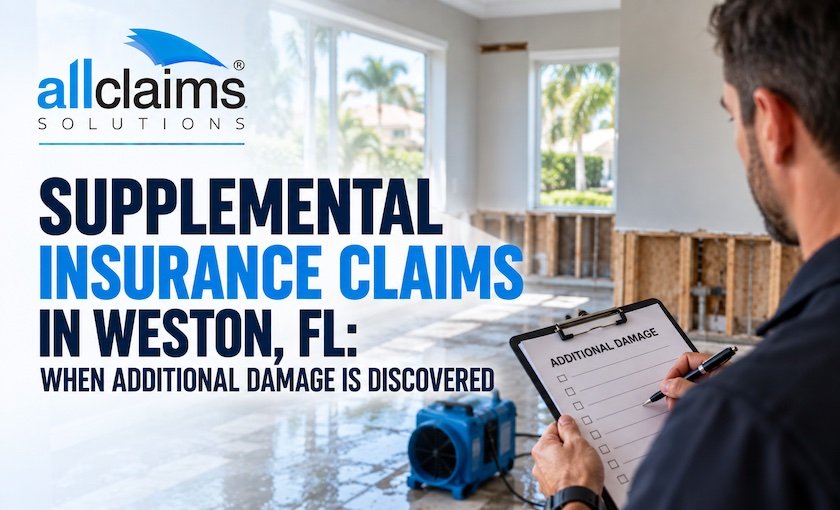
Discovering additional property damage after an insurance claim has already been filed can be frustrating.
You may initially believe that the insurance company’s estimate covers the full loss, only to discover additional damage when repairs begin. Hidden water damage may be found behind walls. A contractor may identify additional roof damage. Materials may cost more than originally estimated. Or damage that was not visible during the first inspection may become apparent later.
In these situations, a supplemental insurance claim may be an option.
A supplemental claim allows a policyholder to seek additional compensation for covered loss or damage from the same peril when the original claim did not fully account for the loss.
Florida law specifically defines a supplemental claim as a claim for additional loss or damage from the same peril that the insurer previously adjusted, or for costs incurred while completing repairs or replacement under an open claim for which timely notice was previously provided.
For property owners in Weston, understanding when and how to file a supplemental insurance claim can be important—particularly after hurricanes, windstorms, severe rain, roof damage, water damage, and other property losses.
What Is a Supplemental Insurance Claim?
A supplemental insurance claim is essentially a request to add additional covered damage or costs to an existing property insurance claim.
For example, imagine that a Weston homeowner files a claim after a severe storm damages the roof.
The insurance company inspects the property and initially estimates:
- Roof repairs
- Interior ceiling repairs
- Minor drywall damage
The homeowner begins the repair process.
During the work, the contractor discovers:
- Additional roof decking damage
- Wet insulation
- Hidden moisture behind drywall
- Additional interior damage
- Higher material or labor costs associated with covered repairs
If those additional losses arise from the same covered event and are otherwise covered under the policy, they may potentially be presented as part of a supplemental claim.
The important point is that a supplemental claim is not simply a request for “more money.”
It should be supported by new or additional evidence of covered loss.
Why Is Additional Damage Sometimes Discovered Later?
Not all property damage is immediately visible.
This is particularly common with water, roof, hurricane, and storm damage.
Some examples include:
Hidden water damage
Water may penetrate:
- Drywall
- Insulation
- Flooring
- Cabinets
- Framing
- Other concealed areas
The visible damage may be only a small portion of the actual loss.
Roof damage
A roof may appear repairable from the ground, while a professional inspection later identifies:
- Damaged shingles
- Roof decking damage
- Flashing problems
- Underlayment damage
- Structural issues
- Water intrusion
Storm damage
Wind and severe weather can damage multiple components of a property.
Initial inspections may not identify every affected area.
Repairs reveal additional damage
Sometimes the original condition cannot be fully evaluated until damaged materials are removed.
For example, removing wet drywall may reveal additional moisture or damaged framing behind it.
Construction costs change
A contractor may determine that the scope of work requires additional materials, labor, permits, or specialized work that was not included in the original estimate.
Whether those costs are covered depends on the policy, cause of loss, and circumstances of the claim.
When Should You Consider a Supplemental Insurance Claim?
A supplemental claim may be worth considering when you discover additional covered damage or legitimate covered repair costs that were not adequately included in the original claim.
Common situations include:
- Additional roof damage is discovered
- Hidden water damage is identified
- Additional structural damage is found
- Repairs reveal damage that was not visible initially
- The original estimate omitted covered components
- Contractor documentation identifies additional covered work
- The cost of covered repairs is higher than initially estimated
- Additional damage from the same covered event is documented
- Personal property damage is discovered later
- Additional eligible expenses arise during the repair process
However, not every new expense automatically qualifies for a supplemental claim.
The additional loss generally needs to be connected to the same peril and supported by appropriate documentation.
Supplemental Claim vs. Reopened Claim: What’s the Difference?
This is one of the most important distinctions for Florida property owners.
Florida law defines the terms separately.
A reopened claim is a claim that the insurer previously closed and that is reopened at the policyholder’s request for additional costs related to loss or damage that had previously been disclosed to the insurer.
A supplemental claim, on the other hand, involves additional loss or damage from the same peril that the insurer previously adjusted, or costs incurred while completing repairs or replacement under an open claim for which timely notice was already provided.
Simple example
Supplemental claim:
Your hurricane claim is still being handled. During repairs, additional covered roof damage is discovered.
Reopened claim:
The insurer previously closed the claim. Later, you request that the insurer reopen it regarding additional costs for damage that had already been disclosed.
The appropriate path depends on the facts of the claim and the policy.
How Long Do You Have to File a Supplemental Claim in Florida?
This is an important issue for Weston property owners.
Under current Florida Statute §627.70132, a supplemental property insurance claim generally must be reported within 18 months after the date of loss, in accordance with the terms of the policy.
For weather-related claims such as hurricanes, tornadoes, windstorms, and severe rain, Florida law provides specific rules for determining the date of loss.
The Florida Department of Financial Services also advises consumers that supplemental property claims generally must be reported within 18 months of the date of loss.
Important:
Do not wait until the deadline approaches.
Your insurance policy may contain additional requirements regarding notice, documentation, proof of loss, repairs, and cooperation.
If you discover additional damage, it is generally better to document it and address it promptly.
What If You Discover Additional Damage During Repairs?
This is one of the most common situations involving supplemental claims.
Imagine a storm damages your roof in Weston.
The insurance company inspects the property and approves a limited scope of repairs.
A contractor begins removing damaged roofing materials and discovers additional damage underneath.
Before proceeding with significant additional work, consider documenting:
- The newly discovered damage
- Photographs and video
- The location of the damage
- The relationship between the damage and the original loss
- Contractor findings
- Updated repair estimates
- Invoices
- Material costs
- Inspection reports
Depending on the circumstances, the insurer may need an opportunity to inspect the newly discovered damage.
Do not assume that because a contractor identifies additional damage, the insurance company will automatically pay for it.
The additional damage still needs to be evaluated under the policy.
How to Document Additional Damage for a Supplemental Claim
Documentation is one of the most important parts of a supplemental insurance claim.
Consider creating a complete record of the additional loss.
Take photographs and videos
Photograph:
- The newly discovered damage
- The surrounding area
- The original damaged areas
- Removed materials
- Roof components
- Interior damage
- Structural damage
- Personal property
Whenever possible, take both close-up and wider photographs showing where the damage is located.
Keep contractor documentation
Ask your contractor for detailed documentation showing:
- What additional damage was discovered
- Where it was found
- Why the additional work is necessary
- What materials are required
- Labor requirements
- Updated estimates
- Photographs
- Invoices
A detailed estimate can be much more useful than simply providing a revised total.
Keep receipts
Save receipts for reasonable temporary repairs and other potentially covered expenses.
Florida consumer guidance recommends making reasonable temporary repairs to prevent further damage and keeping accurate records and receipts.
Preserve damaged materials when practical
Do not automatically throw away damaged property or materials.
Florida DFS consumer guidance recommends documenting damage and not discarding damaged items without prior approval from the insurance company.
Can a Contractor File a Supplemental Insurance Claim for You?
A contractor can provide estimates, photographs, invoices, and information about the work required.
However, adjusting an insurance claim is a regulated activity in Florida.
Florida’s Department of Financial Services explains that a public adjuster represents the policyholder in the insurance claims process, while contractors perform repair and construction services.
This distinction matters.
A contractor can explain the work needed to repair a property, but that does not automatically make the contractor your insurance claims representative.
What If the Insurance Company Says the Additional Damage Isn’t Covered?
An insurer may determine that additional damage is:
- Not related to the original loss
- Caused by a different peril
- Excluded under the policy
- Related to wear and tear
- Related to maintenance
- Outside the scope of the original claim
- Insufficiently documented
- Not supported by the available evidence
If this happens, carefully review the insurer’s explanation.
Ask:
- What caused the additional damage?
- Why does the insurer believe it is not covered?
- What policy provision supports the decision?
- Was the new damage inspected?
- Was the contractor’s documentation considered?
- Does additional evidence support a different conclusion?
The goal should be to understand the coverage position, rather than simply requesting a larger payment.
What If Your Original Insurance Claim Was Underpaid?
A supplemental claim can also become relevant when the original estimate does not fully reflect the scope of covered damage.
For example, an initial estimate might include basic drywall replacement but fail to account for other covered components that become apparent during the repair process.
Possible areas that may require further documentation include:
- Roofing components
- Drywall
- Flooring
- Cabinets
- Insulation
- Electrical components
- Structural repairs
- Personal property
- Additional covered repairs
The key is that the additional amount should be tied to covered loss and supported by evidence.
This is different from simply disagreeing with the insurer’s estimate.
Can You File a Supplemental Claim After Receiving an Insurance Payment?
Potentially, yes, depending on the circumstances.
Receiving an initial insurance payment does not necessarily mean that every aspect of the claim has been fully resolved.
For example, additional covered damage may be discovered while repairs are underway.
However, the terms of the policy, claim status, settlement documents, deadlines, and applicable law should be reviewed before assuming that additional recovery is available.
This is especially important if you signed a document that purports to fully release or settle certain aspects of the claim.
What If the Insurance Company Already Closed My Claim?
If the insurer has closed the claim, the issue may involve a reopened claim rather than a supplemental claim, depending on the circumstances.
Florida law defines a reopened claim as a previously closed claim that is reopened upon the insured’s request for additional costs for loss or damage previously disclosed to the insurer.
That distinction can matter because the documentation and procedural approach may be different.
If you are unsure whether your situation is a supplemental or reopened claim, reviewing the claim history and policy can help determine the appropriate next step.
Do Supplemental Claims Only Apply to Hurricane Damage?
No.
Supplemental claims can arise from different covered perils.
For example:
- Hurricane damage
- Wind damage
- Severe rain
- Storm damage
- Water damage
- Fire damage
- Lightning damage
- Other covered property losses
The important consideration is whether the additional loss is connected to the same peril covered by the original claim and whether the policy provides coverage.
Florida Statute §627.70132 defines supplemental claims in terms of additional loss or damage from the same peril.
Supplemental Insurance Claims After Hurricane Damage in Weston
Hurricane claims are particularly likely to involve supplemental damage because property damage can be extensive and difficult to identify during an initial inspection.
A hurricane may affect:
- Roofing
- Exterior walls
- Windows and doors
- Gutters
- Soffits
- Fascia
- Screens
- Fencing
- Interior ceilings
- Drywall
- Flooring
- Electrical systems
- HVAC equipment
- Personal property
Some damage may not become apparent until the property is thoroughly inspected or repairs begin.
This is one reason why comprehensive documentation from the beginning of a claim is so important.
What Should You Do If You Discover Additional Damage?
If you discover additional damage after filing an insurance claim in Weston, consider these steps:
1. Stop and document the new damage
Take photographs and videos before making unnecessary alterations.
2. Determine what caused it
Try to establish whether the additional damage appears connected to the original covered event.
3. Notify the insurer
Follow the notice requirements in your policy and applicable Florida law.
4. Obtain detailed repair documentation
Ask your contractor or qualified professional to explain the newly discovered damage.
5. Preserve evidence
Keep photographs, damaged materials when practical, estimates, receipts, invoices, and correspondence.
6. Review your original claim
Compare the newly discovered damage with:
- The original estimate
- The insurer’s scope
- Inspection reports
- Your original photographs
- Contractor documentation
7. Consider professional claim assistance
If the claim is complex, disputed, underpaid, or involves substantial additional damage, a licensed public adjuster may be able to help evaluate and present the additional claim.
Can a Public Adjuster Help With a Supplemental Claim in Weston?
Yes, a licensed public adjuster can assist a policyholder with the insurance claims process, including documenting and presenting a claim to the insurer.
Florida DFS explains that public adjusters represent the policyholder—not the insurance company—and can assist with claim documentation, filing requirements, and presenting the claim.
A public adjuster may be particularly useful when:
- Additional damage is substantial
- The original claim was underpaid
- The cause of additional damage is disputed
- The insurer disagrees with the contractor’s scope
- Hidden damage has been discovered
- Multiple areas of the property are involved
- The original estimate appears incomplete
- The claim involves complex storm or hurricane damage
A public adjuster does not guarantee a particular settlement. Their role is to represent the policyholder and help document, prepare, and negotiate the claim based on the policy and available evidence.
How All Claims Solutions Can Help With a Supplemental Claim
At All Claims Solutions, our role is to represent property owners during the insurance claims process.
For a supplemental claim, that can involve helping evaluate:
- The original claim
- The insurer’s estimate
- Newly discovered damage
- Contractor estimates
- Photographic evidence
- Repair documentation
- Policy provisions
- The relationship between the additional damage and the original loss
The objective is to build a well-documented claim that accurately presents the covered loss to the insurance company.
Supplemental Insurance Claim Checklist
If you discover additional damage after an insurance claim, keep this checklist handy:
☐ Photograph the newly discovered damage
☐ Record video when useful
☐ Document where the damage was found
☐ Determine the likely cause
☐ Notify your insurance company promptly
☐ Obtain a detailed contractor estimate
☐ Keep invoices and receipts
☐ Preserve damaged materials when practical
☐ Compare the new findings with the original estimate
☐ Keep all communication with the insurer
☐ Review applicable claim deadlines
☐ Consider professional claim assistance if the claim is disputed or complex
Frequently Asked Questions About Supplemental Insurance Claims in Weston
A supplemental insurance claim is a request for additional covered loss or damage related to the same peril after an initial property insurance claim has already been submitted or adjusted.
Under current Florida law, notice of a supplemental property insurance claim generally must be provided within 18 months after the date of loss, in accordance with the policy.
Potentially. Receiving an initial payment does not necessarily mean that additional covered damage cannot be presented. However, the policy, claim documents, settlement terms, and applicable deadlines should be reviewed.
A supplemental claim generally involves additional loss or damage from the same peril, while a reopened claim involves a claim that was previously closed and then reopened for additional costs related to loss or damage previously disclosed.
It may, if the additional damage is covered under the policy and is related to the original covered peril. Proper documentation is important.
Yes, potentially. Hurricane claims can involve additional damage discovered during inspections or repairs. Florida law provides specific notice rules for property claims resulting from weather-related events.
Review the denial carefully, including the policy provisions cited by the insurer. Additional documentation, professional evaluation, or other claim-resolution options may be appropriate depending on the circumstances.
It depends on the complexity of the claim. A licensed public adjuster may be helpful when significant additional damage has been discovered, the original claim was underpaid, or the insurer disputes the scope or cause of the additional loss.
Don’t Leave Newly Discovered Damage Out of Your Insurance Claim
Discovering additional damage after an insurance claim has already been filed does not necessarily mean you have missed your opportunity to address it.
A supplemental claim may allow eligible additional damage or repair costs to be presented to the insurance company, provided the loss is covered, properly documented, and reported within the applicable requirements.
For Florida property owners, timing matters. Current Florida law generally provides 18 months from the date of loss to report a supplemental property insurance claim, but your policy and the specific circumstances of your loss also matter.
If you have discovered additional damage after an insurance claim in Weston, All Claims Solutions can help you understand the next steps and evaluate how the additional damage may fit within your existing claim.
Need Help With a Supplemental Insurance Claim in Weston, FL?
This article is for general informational purposes only and does not constitute legal advice or a determination of insurance coverage. Insurance coverage depends on the specific policy, endorsements, exclusions, deductibles, limits, and circumstances of the loss. Florida insurance laws and requirements may change.
Schedule Your Free Property Inspection
All Claims Solutions – Weston, FL
📍 2645 Executive Park Dr. Suite 629, Weston, FL 33331
📞 (954) 622-0088
allclaimssolutions.com
Types of Claims in Weston FL
Water Damage >
Fire Damage >
Storm Damage >
Flood Damage >
Mold damage >
Structural Damage >