
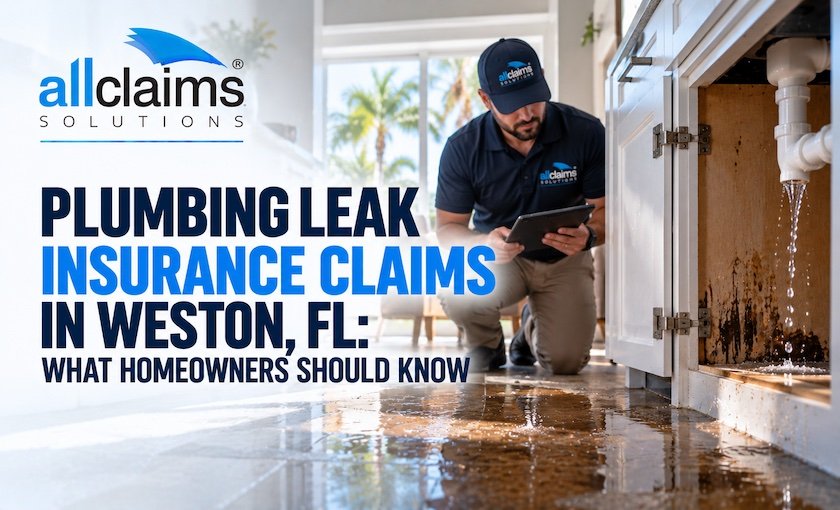
A plumbing leak can cause significant damage to a Weston home in a surprisingly short amount of time. A burst pipe, leaking supply line, failed water heater, broken appliance hose, or hidden plumbing leak can damage floors, walls, ceilings, cabinets, personal belongings, and other parts of the property.
For homeowners, one of the biggest questions is often:
Will homeowners insurance cover the damage caused by a plumbing leak?
The answer depends on several factors, including what caused the leak, how suddenly the damage occurred, the terms of your policy, and whether the resulting damage is covered.
If your Weston home has suffered water damage from a plumbing problem, understanding how insurance claims work can help you protect your property, document the damage, and make informed decisions about your claim.
Does Homeowners Insurance Cover Plumbing Leaks in Weston, FL?
In many situations, homeowners insurance may provide coverage for sudden and accidental water damage resulting from a covered plumbing problem.
However, insurance coverage is not automatically guaranteed simply because water came from a pipe.
The insurance company may consider:
- What caused the plumbing leak
- Whether the leak was sudden or gradual
- Whether the damage resulted from a covered event
- Whether the homeowner knew about a problem before the loss
- Whether reasonable steps were taken to prevent additional damage
- What exclusions and endorsements are included in the policy
- Whether the damaged property is covered under the policy
For example, a sudden pipe failure that releases a large amount of water may be treated differently from a slow leak that has been occurring for months.
The specific language of your insurance policy ultimately controls the coverage determination.
Common Plumbing Problems That Can Lead to Insurance Claims
Plumbing-related damage can originate from many different parts of a home.
Some common sources include:
Burst or Broken Pipes
A broken pipe can release a substantial amount of water into the property.
Water may spread through:
- Walls
- Ceilings
- Flooring
- Cabinets
- Insulation
- Electrical components
- Personal belongings
A relatively small plumbing failure can therefore become a much larger property insurance claim.
Leaking Supply Lines
Supply lines connected to sinks, toilets, washing machines, refrigerators, and other fixtures can fail unexpectedly.
Because these lines may be located inside cabinets or behind appliances, homeowners may not notice the leak immediately.
Water Heater Leaks
A failed water heater can release significant amounts of water, potentially affecting flooring, drywall, baseboards, furniture, and nearby rooms.
Washing Machine or Dishwasher Leaks
A failed hose, connection, or appliance component can result in substantial water damage.
Hidden Plumbing Leaks
Hidden leaks can be particularly difficult because the source may not be immediately visible.
Water may travel behind walls, underneath flooring, or through ceilings before the homeowner notices signs of damage.
Sudden Plumbing Damage vs. Long-Term Leaks
One of the most important distinctions in a plumbing leak insurance claim is whether the damage resulted from a sudden event or a long-term condition.
A sudden plumbing failure may involve an unexpected event such as:
- A pipe suddenly breaking
- A supply line unexpectedly bursting
- A water heater suddenly failing
- An appliance hose unexpectedly rupturing
A long-term leak may involve:
- Continuous dripping
- Deteriorated plumbing
- Corrosion
- Repeated leaks
- Poor maintenance
- Long-term seepage
Insurance policies can treat these situations differently.
In some cases, the resulting water damage may be covered even when the failed component itself is not.
That distinction is important.
For example, an insurance policy may potentially address certain resulting damage to walls, flooring, or other covered property while excluding the cost of replacing a worn-out pipe or failed component.
Do not assume that an insurance company will automatically cover—or exclude—the entire loss. Review the policy and circumstances of the specific claim.
What Damage Can a Plumbing Leak Cause?
A plumbing leak can affect much more than the area where the water first appeared.
Depending on the severity and location of the leak, homeowners may experience damage to:
Structural Components
- Drywall
- Ceilings
- Flooring
- Subfloors
- Baseboards
- Framing
- Cabinets
Personal Property
- Furniture
- Electronics
- Clothing
- Appliances
- Household belongings
Other Areas of the Home
Water can travel through walls, floors, and ceilings and affect rooms that are not directly adjacent to the plumbing failure.
This is why homeowners should avoid assuming that the visible damage represents the full extent of the loss.
Hidden moisture can create additional problems if it is not properly identified and addressed.
What Should You Do After a Plumbing Leak?
If your Weston home experiences a plumbing leak, your first priority should be safety and mitigation.
1. Stop the Source of Water
If it is safe to do so, shut off the water supply or take reasonable steps to stop the leak.
2. Prevent Additional Damage
Florida’s Department of Financial Services advises insureds to take reasonable steps to mitigate additional property damage, including making appropriate temporary repairs and keeping records and receipts.
Depending on the circumstances, this could include:
- Removing standing water
- Moving undamaged belongings away from the affected area
- Covering exposed areas
- Arranging appropriate emergency mitigation
- Taking reasonable temporary measures to prevent additional damage
Avoid making permanent repairs before the damage has been properly documented and inspected whenever possible.
3. Document the Damage
Take photographs and videos of:
- The source of the leak
- Visible water damage
- Walls and ceilings
- Flooring
- Cabinets
- Furniture
- Personal belongings
- Any affected rooms
Keep copies of invoices, receipts, estimates, and other documentation related to emergency services and repairs.
4. Notify Your Insurance Company
Notify your insurance company as soon as reasonably possible and follow the reporting requirements in your policy.
Florida law currently generally requires an initial or reopened property insurance claim to be reported within one year after the date of loss, while supplemental claims generally must be reported within 18 months. Policy requirements can also apply, so homeowners should not wait unnecessarily to report a loss.
Don’t Throw Away Damaged Property Too Quickly
After a plumbing leak, it can be tempting to immediately dispose of damaged belongings.
However, damaged property can sometimes be important evidence when documenting an insurance claim.
Before discarding significantly damaged items, consider:
- Photographing them from multiple angles
- Documenting their approximate age
- Recording model and serial numbers when available
- Keeping purchase receipts if available
- Asking the insurance company about the appropriate next steps
Florida DFS recommends documenting damaged property and keeping records associated with the loss.
Why Plumbing Leak Claims Can Become Complicated
At first glance, a plumbing leak may seem like a straightforward water damage claim.
But insurance companies may need to determine several different issues.
What caused the leak?
Was it a sudden pipe failure, appliance connection, water heater, deteriorated plumbing, or another cause?
When did the damage occur?
Was the damage sudden, or did moisture accumulate over an extended period?
How extensive is the damage?
Visible damage may not represent the complete scope of the loss.
What does the policy cover?
The policy may contain specific provisions regarding water damage, resulting damage, exclusions, deductibles, limitations, and additional coverage.
What will it cost to restore the property?
The cost of drying, demolition, reconstruction, flooring, cabinets, drywall, painting, and replacing damaged contents can add up quickly.
These questions can make a plumbing leak claim more complicated than it initially appears.
What If the Insurance Company Says the Plumbing Leak Isn’t Covered?
A claim may be denied or partially covered for different reasons.
For example, an insurer may argue that:
- The damage resulted from wear and tear
- The leak occurred gradually
- The homeowner failed to mitigate the damage
- The damaged component itself is excluded
- Certain resulting damage is excluded
- The damage falls under a policy exclusion
- The amount of damage claimed is not supported by documentation
A denial or partial payment does not necessarily mean there is nothing else to review.
If you disagree with the insurance company’s position, carefully review the denial letter, estimate, policy language, photographs, reports, and other claim documentation.
What If You Discover More Damage After the Initial Inspection?
This is particularly important with plumbing leaks.
Water can remain hidden behind:
- Drywall
- Cabinets
- Flooring
- Baseboards
- Walls
- Insulation
Additional damage may become apparent during mitigation or repairs.
If additional covered damage is discovered, homeowners should document it and communicate with the insurer promptly.
Florida law distinguishes between reopened claims and supplemental claims, and current statutory deadlines generally provide one year for initial/reopened claims and 18 months for supplemental claims after the date of loss.
Because claim circumstances and policy requirements can vary, homeowners should address newly discovered damage without unnecessary delay.
When Should You Consider Hiring a Public Adjuster?
A public adjuster represents the policyholder, rather than the insurance company.
According to the Florida Department of Financial Services, public adjusters can assist policyholders with preparing and presenting insurance claims and negotiating with the insurer. Public adjusters must be licensed by the state.
For a plumbing leak claim, a public adjuster may help with areas such as:
- Evaluating the scope of property damage
- Reviewing the insurance policy
- Documenting visible and potentially hidden damage
- Preparing claim documentation
- Organizing estimates and supporting information
- Identifying potentially overlooked components of the loss
- Communicating with the insurance company
- Reviewing an insurer’s estimate or settlement offer
- Negotiating the claim on the policyholder’s behalf
This can be particularly useful when a plumbing claim involves significant water damage, disputed coverage, a partial payment, or additional damage discovered during repairs.
A public adjuster cannot guarantee that an insurance company will approve a claim or pay a particular amount.
Public Adjuster vs. Contractor: What’s the Difference?
Homeowners sometimes confuse these two roles.
A contractor focuses primarily on repairing or rebuilding the property.
A public adjuster focuses on the insurance claim and represents the policyholder in the claim process.
They can have different but complementary roles.
For example:
Contractor:
Determines how the property can be repaired and provides repair-related information and estimates.
Public Adjuster:
Helps document, prepare, present, and negotiate the insurance claim on behalf of the homeowner.
Florida also regulates who may adjust an insurance claim on behalf of an insured. A contractor should not act as the policyholder’s insurance claim adjuster unless properly licensed to do so.
How All Claims Solutions Can Help With a Plumbing Leak Claim in Weston
At All Claims Solutions, we help Florida property owners navigate the insurance claim process when their property has suffered damage.
For homeowners in Weston dealing with plumbing-related water damage, our team can help evaluate the claim, document the loss, review the available coverage, prepare claim documentation, and communicate with the insurance company.
Every insurance policy and loss is different, so the first step is understanding what happened, what was damaged, and what the policy may provide.
Dealing With Plumbing Damage in Weston?
Don’t wait until additional damage becomes more difficult to document.
Contact All Claims Solutions for a free insurance claim evaluation and learn what options may be available for your property damage claim.
Plumbing Leak Insurance Claim Checklist
Before moving forward with your claim, consider documenting:
☐ Date and time the leak was discovered
☐ Source of the plumbing leak
☐ Photos and videos of the damage
☐ Affected rooms and areas
☐ Damaged flooring, walls, ceilings, and cabinets
☐ Damaged personal belongings
☐ Emergency mitigation invoices
☐ Repair estimates
☐ Plumbing reports or invoices
☐ Insurance policy information
☐ Insurance claim number
☐ Correspondence with the insurance company
☐ Insurance inspection reports and estimates
☐ Additional damage discovered during repairs
Keeping organized documentation can make it easier to explain the scope and circumstances of the loss.
Frequently Asked Questions About Plumbing Leak Insurance Claims in Weston, FL
A homeowners policy may cover certain damage resulting from a sudden and accidental burst pipe, depending on the policy terms and circumstances of the loss. The cost of the failed pipe or component itself may be treated differently from resulting property damage.
It may, depending on the cause of the leak, the timing of the damage, and the policy’s coverage and exclusions. A policy review is important before assuming that the entire loss is covered or excluded.
Coverage for gradual or long-term leaks can be more complicated. Policies may contain exclusions related to wear, deterioration, or long-term seepage. The specific facts and policy language should be reviewed.
Review the insurer’s estimate and explanation carefully. Compare it with the documented damage and repair information. If you believe covered damage was omitted or undervalued, consider having the claim independently reviewed.
Potentially, depending on the circumstances and policy. Florida law currently provides an 18-month statutory notice period for supplemental property insurance claims, subject to the requirements of the law and the policy.
It depends on the complexity and size of the loss. A public adjuster may be helpful when the claim involves substantial damage, disputed coverage, a partial payment, complicated documentation, or additional damage discovered during repairs.
Florida regulates public adjuster fees. Current Florida guidance states that fees are generally limited to 20% for non-disaster claims and may be limited to 10% for claims caused by a disaster declared by the Governor during the applicable period. Contract and cancellation rules also apply.
Need Help With Plumbing Leak Insurance Claims in Weston FL
This article is for general informational purposes only and does not constitute legal advice or a determination of insurance coverage. Insurance coverage depends on the specific policy, endorsements, exclusions, deductibles, limits, and circumstances of the loss. Florida insurance laws and requirements may change.
Schedule Your Free Property Inspection
All Claims Solutions – Weston, FL
📍 2645 Executive Park Dr. Suite 629, Weston, FL 33331
📞 (954) 622-0088
allclaimssolutions.com
Types of Claims in Weston FL
Water Damage >
Fire Damage >
Storm Damage >
Flood Damage >
Mold damage >
Structural Damage >