
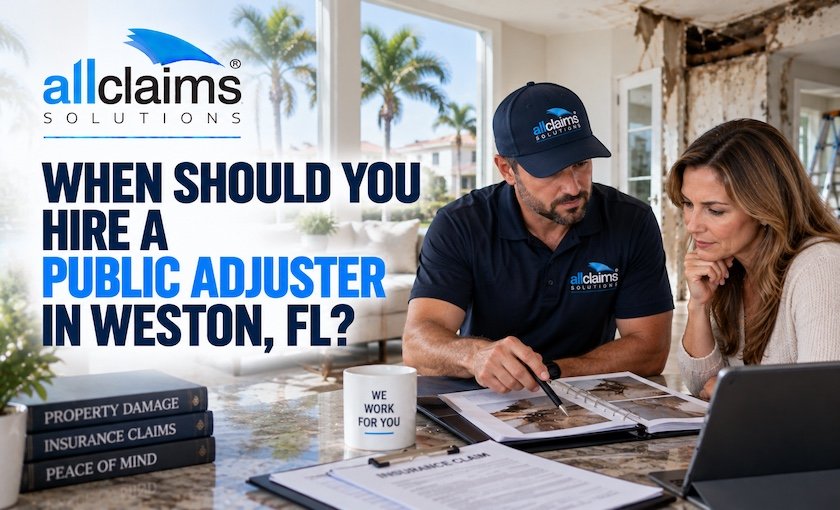
Not every insurance claim requires professional claim assistance.
Some property owners are comfortable communicating directly with their insurance company, documenting their damage, and managing the claim themselves.
Other situations can become considerably more complicated.
A property owner in Weston may want to consider working with a public adjuster when a claim involves extensive property damage, complicated documentation, a disputed scope of loss, a denied or underpaid claim, or additional damage discovered during the process.
The important question isn’t simply:
“Should I hire a public adjuster?”
A better question is:
“Has my insurance claim become complicated enough that professional claim assistance would be useful?”
This guide explains the situations in which a public adjuster may be worth considering, what they can do, what they cannot do, and what Florida property owners should understand before signing a contract.
What Is a Public Adjuster?
A public adjuster is an insurance professional who represents the policyholder in the property insurance claim process.
Under Florida law, a public adjuster may prepare, complete, or file an insurance claim for an insured and may act on the insured’s behalf in negotiating or attempting to settle a covered property insurance claim. Public adjusters are regulated and must be licensed.
This is different from an insurance company adjuster.
Insurance Company Adjuster
The insurance company’s adjuster investigates and evaluates the claim on behalf of the insurer.
Public Adjuster
A public adjuster works for the policyholder and may assist with:
- Inspecting property damage
- Documenting the loss
- Reviewing the insurance policy
- Preparing claim documentation
- Developing the scope of loss
- Organizing supporting evidence
- Communicating with the insurer
- Negotiating the claim
A public adjuster does not guarantee that an insurance claim will be approved or that a particular settlement amount will be obtained.
When Should You Hire a Public Adjuster in Weston?
There is no single point at which every property owner should hire a public adjuster.
However, several situations can make professional claim assistance worth considering.
1. The Damage Is Extensive or Involves Multiple Areas
A small, straightforward loss may be relatively easy to document.
A major loss can be very different.
For example, a hurricane may cause:
Roof damage → water intrusion → ceiling damage → flooring damage → contents damage
A fire may involve:
Fire damage → smoke and soot → water from firefighting → structural damage → personal property damage
The more components involved, the more difficult it can become to accurately document the full scope of the claim.
A public adjuster may help organize the different categories of damage and prepare the claim documentation.
2. You Are Not Sure What Damage Should Be Documented
Property owners often focus on the most obvious damage.
But an insurance claim can involve more than what is immediately visible.
Depending on the loss, additional areas may require evaluation, including:
- Walls
- Ceilings
- Flooring
- Cabinets
- Insulation
- HVAC systems
- Electrical components
- Structural elements
- Personal property
- Additional living expenses
For example, a water leak may appear to have damaged only one room, while moisture may have traveled behind walls or underneath flooring.
A detailed inspection can help establish the scope of the loss.
3. Your Insurance Company Has Provided an Estimate You Don’t Understand
Insurance estimates can contain technical terminology, line items, depreciation, deductibles, exclusions, and scope decisions that are not always easy for homeowners to interpret.
You may receive an estimate that includes some repairs but excludes other work you believe is necessary.
In this situation, a public adjuster may review:
- The insurer’s estimate
- Property damage documentation
- Repair estimates
- The insurance policy
- Photographs
- Inspection findings
The goal is to understand where the differences come from.
4. You Believe Your Claim Is Underpaid
An insurance company may acknowledge that a covered loss occurred while disagreeing about the amount required to restore the property.
For example, the insurer may pay for part of the damage but omit or dispute:
- Certain repairs
- Replacement of damaged materials
- Additional rooms
- Personal property
- Necessary mitigation
- Certain restoration costs
If you believe the payment does not adequately reflect the documented covered damage, a public adjuster may help review and present the claim.
This is different from saying that a public adjuster can guarantee a higher settlement.
No public adjuster can guarantee a particular insurance payment.
5. Your Insurance Claim Has Been Denied
A denial can make an already stressful situation more complicated.
An insurance company may deny a claim based on its interpretation of:
- The cause of loss
- Policy exclusions
- Coverage limitations
- Timing
- Documentation
- Policy conditions
- The relationship between the reported event and the damage
If your Weston insurance claim has been denied, a public adjuster may be able to review the property damage and claim documentation and help determine how the claim should be presented.
However, public adjusters cannot provide legal advice or act as attorneys in matters outside their authorized insurance-adjusting role. Florida law expressly limits public adjusters from giving legal advice.
If a dispute requires legal advice or litigation, an attorney may be the appropriate professional.
6. Your Claim Is Being Disputed
A claim doesn’t have to be completely denied to become complicated.
You may have a disagreement with the insurer about:
- Cause of damage
- Extent of damage
- Repair methodology
- Replacement vs. repair
- Pricing
- Depreciation
- Coverage
- Policy exclusions
- Additional damage
A public adjuster can help the policyholder document and present the insurance claim and communicate with the insurer about the scope of the covered loss. Florida law specifically contemplates communication between public adjusters and insurers regarding the scope of covered loss.
7. Additional Damage Is Discovered During Repairs
This situation is particularly common with water, storm, roof, and fire losses.
For example, a contractor may begin repairs and discover:
- Hidden water damage
- Damaged subflooring
- Additional drywall damage
- Mold-related conditions
- Additional roof damage
- Smoke contamination
- Damaged insulation
The newly discovered damage should be documented promptly.
Florida law distinguishes between reopened claims and supplemental claims, and current statutory notice periods generally provide one year for a claim or reopened claim and 18 months for a supplemental claim, subject to the applicable policy and circumstances.
This is one reason property owners should avoid waiting unnecessarily when additional damage becomes apparent.
8. You Don’t Have Time to Manage a Complex Claim
A significant property claim can involve considerable administrative work.
You may need to:
- Communicate with adjusters
- Schedule inspections
- Collect estimates
- Document damage
- Inventory belongings
- Review reports
- Respond to requests for information
- Compare estimates
- Track expenses
- Organize claim correspondence
For a large or complicated loss, some property owners may prefer to have a licensed professional handle the insurance claim process on their behalf.
9. You Own a Commercial Property
Commercial claims can involve additional layers of documentation.
A business property claim may include:
- Building damage
- Business personal property
- Equipment
- Inventory
- Furniture
- Business income
- Extra expenses
- Tenant improvements
- Specialized systems
For a business owner, the financial consequences of property damage may extend beyond the physical building.
A public adjuster with commercial claim experience may help organize the property damage and associated claim documentation.
10. You Have a Large or High-Value Loss
The larger the property and the more extensive the damage, the more information may need to be documented.
A significant claim can involve:
- Multiple structures
- Extensive contents
- High-value personal property
- Structural repairs
- Specialized materials
- Large restoration projects
- Temporary living or operating expenses
Property owners dealing with a major loss may want professional assistance simply because of the complexity and volume of information involved.
When You May Not Need a Public Adjuster
Professional claim assistance isn’t necessarily appropriate for every loss.
A homeowner may decide to manage a claim independently when:
- The damage is relatively minor
- The cause is straightforward
- The scope is easy to document
- The insurer’s estimate is clear
- There is little disagreement about the damage
- The property owner is comfortable handling communications
- The claim does not involve complicated coverage questions
The decision ultimately depends on the circumstances of the individual claim.
Should You Hire a Public Adjuster Before or After Filing a Claim?
A public adjuster can become involved at different points in the claim process.
Some property owners seek assistance before filing, particularly when they are dealing with a substantial or complicated loss.
Others contact a public adjuster after:
- The insurer has inspected the property
- An estimate has been received
- The claim has been partially paid
- The claim has been denied
- Additional damage has been discovered
There is no universal requirement that a public adjuster be hired at a particular stage.
However, property owners should be aware of applicable claim deadlines and avoid unnecessarily delaying notice of a loss.
Can You Hire a Public Adjuster After the Insurance Company Has Already Inspected the Property?
In many situations, yes.
A property owner may seek professional claim assistance after an insurer’s inspection has already taken place.
A public adjuster may review:
- The insurer’s estimate
- Inspection photographs
- Reports
- Policy provisions
- Contractor estimates
- Additional damage documentation
However, it is important to preserve the condition of the property and document additional damage as it becomes known.
Can You Hire a Public Adjuster After a Claim Has Been Denied?
A property owner may seek a public adjuster’s assistance after receiving a denial, depending on the circumstances.
The public adjuster can evaluate the claim from the policyholder’s perspective and help with claim presentation and documentation within the scope of their license.
However, a denied claim can sometimes involve legal issues beyond the role of a public adjuster.
If the dispute involves litigation, legal interpretation, or legal rights, consulting an insurance attorney may be appropriate.
How Much Does a Public Adjuster Cost in Florida?
Public adjuster fees are regulated by Florida law.
For residential property and condominium unit owner policies, Florida DFS currently states that the maximum fee is generally:
- 20% of the claim payment for non-disaster claims
- 10% for claims arising from a Governor-declared state of emergency during the applicable one-year period
Specific rules also apply to reopened and supplemental claims and certain early payments.
Florida law also provides that an insured generally may cancel a public adjuster contract within 10 days without penalty or obligation. Different cancellation timing can apply when the contract relates to an event that is the subject of a gubernatorial state of emergency.
Always review the actual contract before signing.
What Should You Look for Before Hiring a Public Adjuster?
Before signing a contract, consider asking:
Is the public adjuster licensed?
Florida DFS recommends verifying the public adjuster’s license.
What experience do they have with your type of claim?
For example:
- Hurricane
- Storm
- Water
- Fire
- Roof
- Mold
- Commercial property
What services are included?
Ask how the public adjuster will assist with:
- Inspection
- Documentation
- Claim preparation
- Communication
- Negotiation
What are the fees?
Make sure you understand how the fee is calculated and what payments it applies to.
What does the contract say about cancellation?
Florida law provides specific cancellation rights, but the contract should clearly explain them.
Who will handle your claim?
Ask who your primary contact will be and how claim updates will be communicated.
Public Adjuster vs. Insurance Attorney
These professionals have different roles.
Public Adjuster
Focuses on the insurance claim and may:
- Document the loss
- Prepare the claim
- Review damage
- Present the claim
- Communicate with the insurer
- Negotiate the claim
Insurance Attorney
Provides legal advice and can represent a client in legal disputes and litigation.
A public adjuster is not a substitute for an attorney when a matter requires legal representation or legal advice.
Public Adjuster vs. Contractor
A contractor and public adjuster also have different responsibilities.
Contractor
Focuses on:
- Repair
- Construction
- Restoration
- Materials
- Labor
- Project execution
Public Adjuster
Focuses on:
- Insurance claim documentation
- Scope of loss
- Claim preparation
- Communication with the insurer
- Claim negotiation
Florida law restricts contractors from performing public adjusting services unless properly licensed and compliant as a public adjuster.
Questions to Ask Yourself Before Hiring a Public Adjuster
If you’re unsure whether professional claim assistance makes sense, consider these questions:
Is the damage significant?
If the loss involves multiple rooms, structures, or categories of property, the claim may require extensive documentation.
Do I understand my policy?
If you’re struggling to understand coverage, exclusions, deductibles, or endorsements, professional assistance may be worth considering.
Do I understand the insurer’s estimate?
If you cannot determine why certain repairs were included or excluded, an independent review may help.
Is the claim disputed?
Disagreements about cause, scope, or valuation can make a claim more complicated.
Has my claim been denied or underpaid?
These situations may justify having the claim independently reviewed.
Has additional damage been discovered?
If the scope of damage has changed, timely documentation becomes particularly important.
Do I have time to manage everything?
A major claim can require significant organization and communication.
A Simple Decision Framework
You can think about the decision this way:
Small + Straightforward Claim
You may be comfortable handling the claim yourself.
Moderate + Complicated Claim
Consider whether professional claim assistance would make the process easier.
Large + Disputed Claim
A licensed public adjuster may be worth considering, particularly when documentation, scope, or valuation is complicated.
Denied + Legally Disputed Claim
Consider both claim assistance and whether legal advice from an insurance attorney is appropriate.
This is not a legal formula; it is simply a practical way to evaluate the complexity of your situation.
What Information Should You Gather Before Meeting With a Public Adjuster?
Having your documents organized can make an initial evaluation more productive.
Consider gathering:
☐ Insurance policy
☐ Declarations page
☐ Date of loss
☐ Claim number
☐ Insurance correspondence
☐ Denial letter, if applicable
☐ Insurance estimate
☐ Photographs
☐ Videos
☐ Contractor estimates
☐ Restoration reports
☐ Inspection reports
☐ Receipts
☐ Personal property inventory
☐ Documentation of temporary repairs
☐ Documentation of additional damage
How All Claims Solutions Can Help Weston Property Owners
At All Claims Solutions, we represent policyholders during the property insurance claim process.
Our team can assist Weston property owners with claims involving:
- Water damage
- Storm damage
- Hurricane damage
- Roof damage
- Fire damage
- Mold
- Structural damage
- Commercial property damage
Depending on the circumstances, our services may include property inspection, documentation, claim preparation, policy review, communication with the insurer, and claim negotiation.
We don’t promise a particular settlement or guarantee that a claim will be approved.
Instead, we focus on helping property owners understand and properly document their insurance claim.
Wondering Whether You Need a Public Adjuster in Weston?
If you’re dealing with significant property damage, a disputed claim, an underpayment, a denial, or additional damage discovered during repairs, All Claims Solutions can evaluate your situation and explain the claim assistance available to you.
Contact All Claims Solutions for a free insurance claim evaluation.
Frequently Asked Questions
Consider professional claim assistance when your property damage is extensive, the claim is complicated, the insurer’s estimate is difficult to understand, additional damage has been discovered, or you disagree with the insurer about the scope or value of the loss.
No. A public adjuster is not necessary for every claim. Some straightforward losses can be managed directly by the property owner.
A licensed public adjuster may assist with preparing and presenting the property insurance claim and reviewing documentation. However, public adjusters cannot provide legal advice, so an attorney may be appropriate when the dispute involves legal issues.
Potentially. A public adjuster may review the insurer’s estimate, document the property damage, prepare supporting claim information, and communicate with the insurer regarding the scope of the covered loss.
It depends on the complexity of the loss. Some property owners seek assistance before filing, while others hire a public adjuster after receiving an estimate, partial payment, or denial.
Yes, a property owner may seek professional claim assistance later in the process, depending on the circumstances.
Potentially. Florida has specific rules governing fees on reopened and supplemental claims, including restrictions on charging fees based on previous payments.
Florida regulates public adjuster fees. Current DFS guidance generally describes a 20% maximum for non-disaster claims and a 10% maximum for claims caused by a Governor-declared emergency during the applicable period, with additional rules for certain payments and reopened/supplemental claims.
Florida law generally allows an insured to cancel a public adjuster contract within 10 days without penalty or obligation. Special rules apply to contracts associated with a gubernatorial state of emergency.
A public adjuster and an insurance attorney have different roles. If the matter involves legal advice, litigation, or legal rights, an attorney may be appropriate.
Need Help With Insurance Claims in Weston FL
This article is for general informational purposes only and does not constitute legal advice or a determination of insurance coverage. Insurance coverage depends on the specific policy, endorsements, exclusions, deductibles, limits, and circumstances of the loss. Florida insurance laws and requirements may change.
Schedule Your Free Property Inspection
All Claims Solutions – Weston, FL
📍 2645 Executive Park Dr. Suite 629, Weston, FL 33331
📞 (954) 622-0088
allclaimssolutions.com
Types of Claims in Weston FL
Water Damage >
Fire Damage >
Storm Damage >
Flood Damage >
Mold damage >
Structural Damage >